
Introduction
Pharmacy has long been a respectable choice in universities. The increasing number of pharmacy graduates in recent years seem to have led to the perceived saturation of the profession though, primarily in the community and hospital pharmacy sectors. Despite being an essential healthcare service, the open positions of pharmacists in these sectors do not seem to have increased with the increasing number of graduates. Similar concerns have been raised in a number of countries including Australia, U.K. and U.S. – a basic Google search would shed some light on that.
While these concerns have their reasons, career options of pharmacy graduates can go far beyond community pharmacies and hospitals. Due to the multidisciplinary nature of the knowledge base covered in a pharmacy course- from chemistry, biology, and formulation science, to communication, management, and customer service – a good pharmacy education provides a strong foundation for a variety of career options. In this post, I would like to share some of my own experience, on what one can do with a pharmacy degree from Australia. While some of the experience are more Australia specific, others are broadly applicable.
Community pharmacist
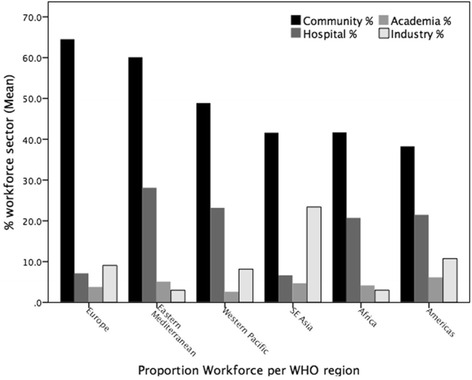
This is understandably the most obvious choice for many and most pharmacists to work as community pharmacists.. In an analysis of global pharmacy workforce, it was reported that on average 55% of pharmacists work in community pharmacies (Figure 1) [1]. Many pharmacy courses were developed to train students to become community pharmacists. The focus on prescription evaluation before dispending and the delivery of primary healthcare services in a community pharmacy setting is a major component of pharmacy education. Every pharmacy student needs to do some placements in community pharmacies. Many of them also work part-time in community pharmacies. In Australia, pharmacy graduates have to do a year of internship in either a community pharmacy or hospital before they can register as a pharmacist. Most pharmacists completed their intern year in community pharmacies.
I started working in community pharmacies when I was a pharmacy student. Since my pharmacist registration, I have worked in many community pharmacies in different capacities – full-time, part-time, locum, in a team, as the sole pharmacist-in-charge, early and late shifts, long and short hours – in big and small pharmacies. Some of them were next to a clinic with a prescription focus, while others also had a spacious shopfront for other retail services.
Hospital pharmacist
After community pharmacy, hospital pharmacy is naturally the next one that comes to mind. According to the Society of Hospital Pharmacists of Australia (SHPA), hospital pharmacists comprise approximately 20% of the pharmacy workforce in Australia [2]. During the early days of my registration, I had relatively limited exposure in hospital pharmacy, primarily from the placements during the pharmacy course. I was therefore interested in expanding my experience to learn more about hospital pharmacy. I started working on the weekend for a hospital shortly afterwards, supporting supply of medications to inpatients, outpatients and ICU. The opportunities and challenges, including the types of patients you see and the interactions you have with other members of healthcare teams, in hospital pharmacy is quite different from community pharmacy. It is worth spending a little time to think through if you have a clear interest in any particular one of them so you can channel your effort in a more targeted way.
Consultant pharmacist
The Australian Association of Consultant Pharmacy (AACP) is the major credentialing body for professional pharmacy cognitive services that are remunerated separately from the supply of medicines. Its primary role is to develop and administer the assessment process leading to the accreditation of registered pharmacists [3]. AACP accredited consultant pharmacists provide medication management review services, during which they review the medications of the patients, discuss with the patients and their carers about any potential issues, and provide feedback to the prescribers on optimisation their medications plan. Registered pharmacists can obtain accreditation by completing the mandatory training courses and assessments. Consultant pharmacists need to complete 60 Continuing Professional Development (CPD) points, in contrast to the 40 CPD points of other registered pharmacist, every year and complete an clinical assessment test every three years to maintain their registration. I obtained my AACP accreditation about two years after my initial registration, and have then worked on medication review for different pharmacies for several years. For the ones who enjoy more direct and in-depth interactions with patients and carers to improve their medication regimens, this can be a great option.
Academia
For the ones who enjoy the university atmosphere, academia is another career option. Being in academia may mean slightly different things to different people. For the sake of the discussion here, let’s take this as working in university settings with an academic track position. Almost all world-leading universities these days are research led, and having a PhD is practically a de facto prerequisite. That means you need to demonstrate that you can do research in an academic setting by first completing a PhD. Given the broad training in the pharmacy course, from fundamental to clinical sciences, there are numerous areas of research one can get into with a pharmacy degree, from areas with a clinical focus such as pharmacy practice and quality use of medicines, to the drug development related disciplines such as drug delivery, pharmaceutical biology and medicinal chemistry. I got a scholarship to do a PhD in pharmaceutics shortly shortly after my registration. I had very little understanding what doing research and a PhD really meant then, and was curious to try it out to see what it would lead me to. It has since then opened me up to a world of possibilities I had never imagined. One thing I would like to point out: academia does not (only) equal to teaching. While teaching is often part of the job, being good at teaching alone can rarely lead to a faculty academic position. Since essentially all major universities are research-led, and research funding and output are driving the reputation and finance of universities, academics often spend more time working in research and grants than teaching. Some institutions offer dedicated teaching positions but they do not seem to be the majority.
Research
Research can take many different forms. In pharmacy, it can be the more fundamental and translational work of pharmaceutical sciences, to the more clinical type of work to improve the quality use of medicines and dosing regimens, or in pharmacy practice and public health. I started my PhD in drug delivery and pharmaceutics. More specifically, it was around the development of inhaled formulations for vaccine delivery to the lung. It was the novelty of the work, the non-conventional thinking in giving drugs and vaccines in a different way, that intrigued me. In addition, I was always interested in pharmacokinetic and pharmacodynamic modelling, and have been expanding my experience in pharmacometrics since my PhD. These interests of my mine have since led me to different places all over the world. In addition to the various international conferences, most notably, I had a chance to move to Europe and further my experience in pharmacometrics and drug delivery in one of the world-leading research groups in the fields in Sweden. During that time, I collaborated with different academic and industrial groups in international matrix teams to support development programmes for new antimicrobials to tackle the antimicrobial resistance crises. I also participated in several clinical projects with clinicians to support dose optimisation of clinical drugs in patients.
Industry
The development of new drug treatments is an extremely multidisciplinary endeavour, and requires a huge amount of investment for each treatment in the billions [4]. Not only is this cost needed for the direct research and development of the successful product, it also has to cover the numerous unsuccessful molecules along the way to allow the development of the successful treatment. Given the vast amount of resources required, both financial input and scientific expertise, the support of the industry is often needed and pharmaceutical companies are responsible for the development of most drug treatments. There are also many biotech companies these days usually with focuses on more selected areas of innovations. I joined the pharmaceutical industry recently to support the development of new treatments and am currently based in Europe.
Regulatory
Drugs have to be approved by regulatory agencies before they can be used and marketed in a country. Some key examples of regulatory agencies include the U.S. Food and Drug Administration (FDA), the European Medicines Agency (EMA), the Pharmaceuticals and Medical Devices Agency (PMDA) in Japan and Therapeutic Goods Administration (TGA) in Australia. Given the sizes of the markets, it is common to see new medicines first being registered with the FDA and EMA, for the U.S. and European markets, respectively, before being submitted for approval in other countries. The regulatory sector is another career pathway for the ones working in the pharmaceutical areas, and I have a few past colleagues who joined the FDA and EMA. If you are in the industry, regulatory interactions for submission is commonplace.
Summary
During the many encounters over the years, I have noticed that “pharmacy” is often associated with only community pharmacy for people outside the profession. For me, I got into pharmacy because of my interest in healthcare and curiosity in drug treatments. I have since come to learn the broad knowledge base covered in the pharmacy training, e.g., from clinical judgement and patient interaction, the various disciplines in the development of new drug treatments, to the understanding of business operation and management. There is so much more in pharmacy than community pharmacy. The broad knowledge and skills you acquire during the pharmacy course can lead you to many interesting places should you choose to do so. For me, and for many of the friends I have come to meet over the years, it has given us a world of possibilities.
References
- Bates I, et al. (2016). An analysis of the global pharmacy workforce capacity. Hum Resour Health. 2016; 14: 61. URL: https://doi.org/10.1186/s12960-016-0158-z
- The Society of Hospital Pharmacists of Australia. About hospital pharmacy. Accessed on 10-Jun-2021. URL: https://www.shpa.org.au/about-hospital-pharmacy.
- The Australian Association of Consultant Pharmacy website. Accessed on 17-Jul-2021. URL: https://aacp.com.au/about-us/about-aacp/
- Wouters OJ, et al. (2020). Estimated Research and Development Investment Needed to Bring a New Medicine to Market, 2009-2018. JAMA. URL: https://jamanetwork.com/journals/jama/fullarticle/2762311
 CAREX
CAREX 
Leave a comment